The hit We Can't Stop by Miley Cyrus from her 2013 Bangerz album, make it to number 2 on the charts and sold over 2 million copies.
Student Details
Student Name: Kelly Campbell
Identification Number: S2918726
Class: 2404HUM Culture, Media, Society
Tutorial: Wednesday 10AM
Assessment: Item 2 Research Journal : Part 2
Overall Word Count: 1214
(Not including Media Item Descriptions or Reference Lists)
Contact Email: Kelly.AnnCampbell@hotmail.com
Identification Number: S2918726
Class: 2404HUM Culture, Media, Society
Tutorial: Wednesday 10AM
Assessment: Item 2 Research Journal : Part 2
Overall Word Count: 1214
(Not including Media Item Descriptions or Reference Lists)
Contact Email: Kelly.AnnCampbell@hotmail.com
Entry 6
The acclaimed pop hit Fancy, made famous by female Australian rapper Iggy Azalea, (as below) makes mention to many different elements of the courses studies.
First and foremost it participates in the previously studied 90's kid subculture, reminiscing quite literally in the popular 1995 film Clueless, staring an array of famous actors from the period. The irony of trends in the 90's being back today, seems aware of itself in the first classroom scene. It would appear almost indefinitely that it's a 90's flashback until you see students on iPhones. The film clip copies some of the most iconic scenes from the movie, imitating to a tee outfits warn originally, which have done the run around and returned back into popular fashion.
Technology from the time is integrated with that of the present seamlessly (below) by using the concept of a wardrobe computer from the film, yet on an iPad and in the form of popular online clothes store, Revolve.

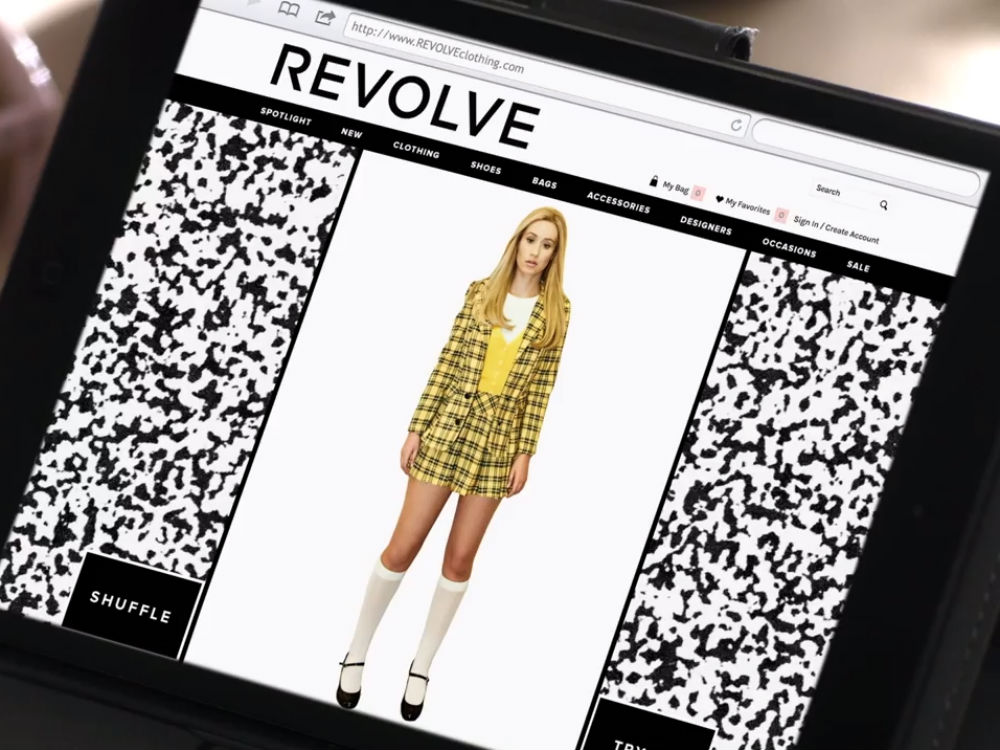
The film clip is somewhat disconnected from the music video, purposely to draw attention to the disparity in the artists sounds to her looks. She challenges all previously conceived assumptions of what a female rapper should look and act like, as well as the music a white, middle class, white Australian girl usually makes.
First and foremost it participates in the previously studied 90's kid subculture, reminiscing quite literally in the popular 1995 film Clueless, staring an array of famous actors from the period. The irony of trends in the 90's being back today, seems aware of itself in the first classroom scene. It would appear almost indefinitely that it's a 90's flashback until you see students on iPhones. The film clip copies some of the most iconic scenes from the movie, imitating to a tee outfits warn originally, which have done the run around and returned back into popular fashion.
Technology from the time is integrated with that of the present seamlessly (below) by using the concept of a wardrobe computer from the film, yet on an iPad and in the form of popular online clothes store, Revolve.
The film clip is somewhat disconnected from the music video, purposely to draw attention to the disparity in the artists sounds to her looks. She challenges all previously conceived assumptions of what a female rapper should look and act like, as well as the music a white, middle class, white Australian girl usually makes.
Entry 5
Celebrity as a term within the course is described as being a personality (in the contemporary context) usually having emerged from the sporting or entertainment industries, highly visible in the media and their private lives will attract a greater public interest than their professional lives (Graeme 2004).
Celebrities are in one way a product of society, not as a living being but their distinction from other humans. Celebrities are essentially more about us than they are them. They are a product of a number of social and cultural processes, in coherence with the media. The celebrity can be described as a walking, talking sign or symbol, notes on any given generation, period, culture, society, group or profession. It should be noted however that what they 'say' on these such elements are not necessarily correct, however the celebrity does not exist without being seen and consumed, so it is often accepted that they stand as a summary. This example is best understood when the most iconic celebrities of the past are considered, and to what extent it is accepted that they recap a certain area.
Did the celebrity exist without forms of media though?
A which came first, the chicken or the egg-esque dilemma, of which week 10's reading and week 11's classes left in my mind.
Resources
Fraser, B. and Brown, W. (2002). Media, celebrities, and social influence: Identification with Elvis Presley. Mass Communication & Society, 5(2), pp.183--206.
Turner, Graeme (2004): "Introduction" in Understanding Celebrity. London: Sage; pp. 3-27
Celebrities are in one way a product of society, not as a living being but their distinction from other humans. Celebrities are essentially more about us than they are them. They are a product of a number of social and cultural processes, in coherence with the media. The celebrity can be described as a walking, talking sign or symbol, notes on any given generation, period, culture, society, group or profession. It should be noted however that what they 'say' on these such elements are not necessarily correct, however the celebrity does not exist without being seen and consumed, so it is often accepted that they stand as a summary. This example is best understood when the most iconic celebrities of the past are considered, and to what extent it is accepted that they recap a certain area.
Did the celebrity exist without forms of media though?
A which came first, the chicken or the egg-esque dilemma, of which week 10's reading and week 11's classes left in my mind.
A study (Fraser, B. and Brown, W. 2002) done on Elvis Presley as a celebrity and the ways in which a broad spectrum of fans and impersonators identify him. Even without media playing the massive role in his life that it does in such big celebrity personalities today, a similar effect is had as discussed above. The surveyed individuals could still identify with his values, way of life and modified their lives to emulate his.
Resources
Fraser, B. and Brown, W. (2002). Media, celebrities, and social influence: Identification with Elvis Presley. Mass Communication & Society, 5(2), pp.183--206.
Turner, Graeme (2004): "Introduction" in Understanding Celebrity. London: Sage; pp. 3-27
Entry 4
Semiotics is the study of meaning making, the philosophical theory of signs and symbols and additionally, symbolically loaded imagery.
Signal crimes (as determined by Professors Martin Innes and Nigel Fielding) capture the social semiotic process where particular crimes and disorderly conduct have a remarkable affect, substantiating in a societies immediate response. Signal crimes more often than not coincide heavily with the media, either as a tool, in response to, or simply for coverage.
I make reference to the below Courier Mail front page, as it is packed full of symbolically loaded imagery and symbolism from which I can transfer theory into practical examples. The media piece was controversial and described as 'insensitively reported'. The headline demonstrates the power of polysemy. The original headline Monster Chef and the She Male, stirred grave community anger after a transgender woman was brutally dismembered by her chef husband. The lack of concrete definition of the terms monster and she male, were the only reason the headline made it to publishing, however not slippery enough to be cleared of being derogatory. The publishing company News Corp attempted to use the symbolically loaded imagery featured with the story, of the victim in her bikinis, posing suggestively, to its advantage. The victim was a professional sex worker and the story read as to discredit her in many ways, this being one of them. It has been pointed out that had the story have been complimented with one of the images used by other publications such as that of her fully dressed and smiling, it would have read differently entirely. Academic writers such as Professors Mathew Gentzkow and Jesse Shapiro (2005) have conducted research, identifying specifically where media firms distort or provide symbols that allure to another meaning, to provide information that conforms with consumers' prior beliefs.
Resources
Signal crimes (as determined by Professors Martin Innes and Nigel Fielding) capture the social semiotic process where particular crimes and disorderly conduct have a remarkable affect, substantiating in a societies immediate response. Signal crimes more often than not coincide heavily with the media, either as a tool, in response to, or simply for coverage.
I make reference to the below Courier Mail front page, as it is packed full of symbolically loaded imagery and symbolism from which I can transfer theory into practical examples. The media piece was controversial and described as 'insensitively reported'. The headline demonstrates the power of polysemy. The original headline Monster Chef and the She Male, stirred grave community anger after a transgender woman was brutally dismembered by her chef husband. The lack of concrete definition of the terms monster and she male, were the only reason the headline made it to publishing, however not slippery enough to be cleared of being derogatory. The publishing company News Corp attempted to use the symbolically loaded imagery featured with the story, of the victim in her bikinis, posing suggestively, to its advantage. The victim was a professional sex worker and the story read as to discredit her in many ways, this being one of them. It has been pointed out that had the story have been complimented with one of the images used by other publications such as that of her fully dressed and smiling, it would have read differently entirely. Academic writers such as Professors Mathew Gentzkow and Jesse Shapiro (2005) have conducted research, identifying specifically where media firms distort or provide symbols that allure to another meaning, to provide information that conforms with consumers' prior beliefs.
Resources
Gentzkow, Mathew. and Shapiro, Jesse (2005). Media bias and reputation.

Entry 3
A subculture, as defined by Hebdige
(2005) represent 'noise' as opposed to sound. A collection of breaks in the
regular, or norms, which when complied represent a group of people, tendencies
and characteristics which differentiate
themselves from the larger culture.
Elements which determine the meaning
of a subculture include all aspects of how one lives their life and see their
world (Hegemony, otherwise known as a total world view), a mindset or Ideology and one or
more commodities (use value found in the process of consumption or exchange
value, found when attempting to
exchange). Reification (the making
real of something, bringing it into being) and Dialectical materialism
(class struggle) also play important roles.
For example; the '90's kid'
subculture. (See video above for example)
Reminiscence for a not too distant
past, idolized as being some of the best years to grow up in. The homology
associated with the subculture is quite literal, in that the development of
those who include themselves in the group were brought up,
surrounded by the same generation of pop culture influences, world
events and technological advances. The 90's kids (individuals who
were brought up from the ages of 5 to 18, during the 1990's)
were arguably the first generation to grow up with world
information systems and the computer, which explains the prominence of the
culture on the internet. It could be described as a platform for the rise of the
90's kids’ movement, which is also referred to the #90's kid (hashtag).
The subculture most commonly
manifests (online) in the phrase 'only 90's kids will get this', or 'if
you remember these you had an awesome childhood'. Both refer to images or
terminologies which would only be identifiable to 90's kids, as they are no
longer prominent or in existence. This side of the subculture makes
obvious the excluding nature evident.
Traits of the subculture are mainly
derived from western culture, often new, consumer level technologies from
during the period, fashion, pop culture or terminology.
Resources
Hebdige, Dick (2005): "Subculture" in Popular Culture, A Reader (eds Raiford Guins and Omayra Zaragoza Cruz). London, Thousand Oaks & New Delhi: Sage Publications; pp.355-71
Entry 2
'Teenage Crime' was released in 2010, during the age of digital music transmission establishing itself as the primary method for audio sharing. The track was recorded using microphones and recording devices, uploaded and shared as a file; listened to 1,532,165 times on YouTube and over 250,000 times on SoundCloud. The tracks success could be attributed to its coverage of various genres. Radio stations are commonly known as the delegators of songs into different categories, each station only playing that which fits its own style (Souvignier, 2003). 'Teenage Crime' falls under the titles of pop, electro, techno and dance, its many spawning remixes extending the songs reach to hardstyle, trance and even house, thus extending the songs playability. Transcendence is factor in a tracks success too, more coverage means higher popularity and sales securing its position into popular culture. The song doubles as an easy listening track to be received during the day as well as to dance to at night, so has multiple settings.
The song has been said to have identifiable authentic qualities within in the vocals and audible instrument, seemingly rare in dance and pop music. Faking It: The Quest For Authentic in Popular Music (Barker and Taylor, 2007) says that listeners condemn 'fakes'. This raises the critical question on how we make value judgements on popular songs. It's a sociocultural process that breaks every of it's own rules when a new trend comes around. But what is a trend and how do the borders of what is included, form? A set of algorithms allegedly establish grey borders of pop culture trends (Beer, n.d.) but even these get it wrong and this mistake is of a high consumption thus, dollar value.
The film clip accompanying this track could be described as illustrative, in the sense that it is loosely based on the narrative of the lyric. Although the four line chorus repeats itself twice and is fairly simple in language, the audience gets a fair understanding from this combined with the beat to what the singer is talking about. Viewed with the music video showing a wife sneaking out to party and it's not long before the connection between the two is understood.
References
Barker, H. and Taylor, Y. (2007). Faking it. 1st ed. New York: W. W. Norton.
Beer, D. (n.d.). Popular culture and new media. 1st ed.
Souvignier, T. (2003). The world of DJs and the turntable culture. 1st ed. Milwaukee, WI: Hal Leonard Corp.
Media Piece 2
Dj and producer Adrian Lux released his biggest hit 'Teenage Crime' in 2010. The track shot up the charts, placed 6th in the Triple J Hottest 100 and circulated around the club scene for the next year combining careless lyrics with a chilled yet knee bending beat.
Entry 1
Enculturation; the constant give and take interaction between forms of media and the audience. The act of listening to (consumption) and immediate feedback of a listener to a song acts as a form of enculturation. A song getting re-requested and making it onto the charts such as the below track 212, asserts the 3 minutes audio clips entry into pop culture, consequential influence on other artists and listeners. Gans and Burton talk about public and private culture(1977, page 6); public being content readily available to the public and private, that of consumer created culture such as parodies, covers, ratings etc.
212 is accepted as being a song due only to social conventions that tell society that the length of sound is such, and should be vocally mimicked and danced to in accordance with a genre code: Dance-cross-rap. Genres tend to derive authenticity, subject matter and audience from their associated subcultures (Souvignier, 2003). The track is a cultural product of Harlem New York, '212' being the area code artist Azealia grew up in, her and her geographical locations life experiences, aspirations and attitudes. Within her lyrics she makes references to the "f*** ya gon' do?" attitude she and her brothers and sisters from Harlem hold, which aligns with rap culture in the sense that youths of the lower class neighbourhoods stick together in defence to the alleged biased authority figure, or the 'other'(Hatfield, 2002).
To break down this specific lyric further, the signifier would be identified as the sound coming from her mouth, the signifier the willingness of the artist to do as she wishes acknowledging that the audience or the 'other' won't stop her, and the referent, her rebellious Harlem attitude. The style in which Azealia delivers her spoken word takes the form of the established culture that is rap, which itself has a variety of style depending on setting, audience, social context and function (Kochman, 1969). The function of the debut single could be compared to the act of modern day peacocking (Urban Dictionary, 2014).
To engage with the song listeners must accept the arbitrariness of language and agree that for three minutes implied meanings of words are as they say. For example 'the 212' would not have been recognisable prior to listening to the song, however after three choruses the listener understands that the artist is referring to Harlem of area code 212. Rap has this tendency to assume prior knowledge such as slang and jabberwocky in its delivery.
Resources
Gans, H. and Burton, D. (1977). Popular Culture and High Culture: An Analysis and Evaluation of Taste. Wiley Online Library.
Hatfield, C. (2002). Youth, Popular Culture and Moral Panics: Penny Gaffs to Gangsta-Rap, 1830-1996 (review). The Lion and the Unicorn, 26(2), pp.265--270.
Kochman, T. (1969). “Rapping” in the black ghetto. Society, 6(4), pp.26--34.
Souvignier, T. (2003). The world of DJs and the turntable culture. 1st ed. Milwaukee, WI: Hal Leonard Corp.
Urban Dictionary, (2014). peacocking. [online] Available at: http://www.urbandictionary.com/define.php?term=peacocking [Accessed 23 Aug. 2014].
Media Piece 1
The track 212 by Azealia Banks samples the complete backing audio from Lazy-Jays 'Float My Boat', which never made the charts. The hit '212' however made it to number 2 on international charts, establishing a firm position in popular music culture for that minute.
Student Details
Student Name: Kelly Campbell
Identification Number: S2918726
Word Count: 782 (Not including Media Item Descriptions or Reference List)
Class: 2404HUM Culture, Media, Society
Tutorial: Wednesday 10AM
Contact Email: Kelly.AnnCampbell@hotmail.com
Identification Number: S2918726
Word Count: 782 (Not including Media Item Descriptions or Reference List)
Class: 2404HUM Culture, Media, Society
Tutorial: Wednesday 10AM
Contact Email: Kelly.AnnCampbell@hotmail.com
Subscribe to:
Posts (Atom)